
Know Exactly How Good
Your AI Agents Are
Three-layer accuracy measurement. Workflow, step, variable. Benchmark against human performance. Auto-retry with self-healing. Real-time dashboards. Test datasets. Evaluation criteria. Feedback loops. Enterprise reporting. Know exactly how good your agents are.
Measure accuracy at every level
Evaluations are the gate between a promising demo and a production deployment. Every execution is scored at the workflow, step, and variable level, so you know exactly what works and what doesn't. Agents earn production readiness with measurable accuracy, not a hunch.
Three-layer accuracy measurement
Workflow level asks did it complete? Step level asks which node failed? Variable level asks which field was wrong? Surgical precision, not guesswork.

Benchmarked against human performance
Compare agent accuracy to your best human operators. Track the gap. Close it systematically. Know when agents exceed human performance.
Auto-retry with self-healing
Accuracy drops below threshold? System auto-retries with optimized prompts. Self-healing agents that fix themselves before you notice.

Real-time accuracy dashboards
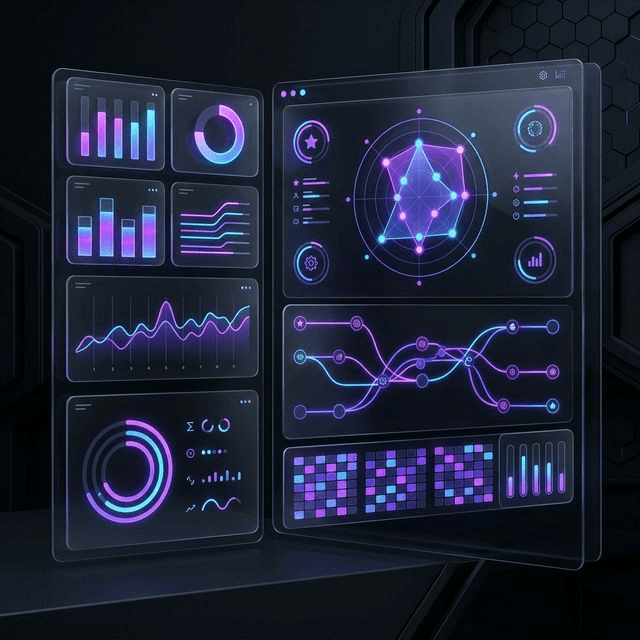
See evaluation scores as tasks complete. Spot degradation immediately. Weekly trends. Monthly reports. Prove ROI with data.
Create test datasets in minutes
Build evaluation datasets from real tasks. Label expected outputs. Run agents against test data. Systematic testing, not random sampling.

Evaluation criteria per node
Define what makes each step a success.

Feedback loops built-in
Thumbs up/down from users. Automatic feedback collection. Feed corrections back to learning. Closed loop improvement.
Enterprise reporting ready
Export accuracy reports for stakeholders. API access to metrics. Integrate with existing BI tools. Automated executive dashboards.
Three-layer accuracy: Know exactly where problems occur
ReinforcedX measures accuracy at three distinct levels. Workflow level asks did the entire task complete successfully? This is your headline metric for overall agent performance. Step level asks which specific node in the workflow failed or underperformed? This identifies problem areas without debugging entire workflows. Variable level asks which individual output field was incorrect? This surgical precision means you optimize the exact thing that's wrong, not everything around it.
Benchmark against human performance. Set the right target
Human operators aren't 100% accurate. They're typically 92-98% depending on task complexity. Benchmarking against human performance means setting realistic targets and measuring actual improvement. When available, ReinforcedX can compare agent outputs to human-generated outputs for the same tasks. Track the accuracy gap over time. Identify where agents exceed human performance and where they still fall short.
Auto-retry and self-healing: Agents that fix themselves
When an execution scores below your configured threshold, the system doesn't just fail. It retries with an optimized approach. Self-healing prompts adjust based on the specific failure. For example, if extraction missed a field, the retry prompt explicitly requests that field. This happens automatically, without human intervention, up to your configured retry limit. Most transient failures resolve on retry. Persistent failures surface for review.
Evaluation Criteria
Configure evaluation criteria per node to define exactly what a correct output looks like. Format validation checks if the date is in ISO format and if the currency is correct. Required fields checks if all mandatory fields are present. Business logic checks if the total matches the sum of line items. Semantic correctness checks if the extracted value matches the source document. The system validates outputs against your criteria automatically, scoring each execution.
Test datasets: Systematic evaluation
Create evaluation datasets from real tasks or synthetic examples. Label expected outputs for each input. Run agents against test datasets to measure accuracy before deployment. Compare results across agent versions. Did that prompt change improve accuracy or break something else? Systematic testing replaces random sampling with statistical confidence.
Feedback loops: Continuous improvement signal
Build feedback collection into your workflows. Thumbs up/down for end users. Detailed corrections for reviewers. Automatic collection from approval workflows. Approved equals positive feedback, rejected equals negative. Feed this signal back into the Learning Hub. Agents improve based on real production feedback, not just initial training. The more you use them, the better they get.
Real-time dashboards: See accuracy as it happens
Analytics dashboard shows evaluation scores in real-time as tasks complete. Six key metrics at a glance. Completion rate, evaluation score, feedback score, average runtime, total runtime, approval rate. Filter by date range (last 7 days, 30 days, 3 months). Visual gauges highlight agents below threshold. Trend charts show improvement (or degradation) over time.
Enterprise reporting: Prove ROI
Export accuracy reports for stakeholder presentations. API access to all evaluation data for custom dashboards. Integrate with existing BI tools (Tableau, Power BI, Looker). Automated weekly/monthly executive summaries.

Start building custom AI agents to automate processes
Join our platform and start building AI agents for various types of automations.
Questions teams ask about evaluations
What does evaluations actually involve?
We design the workflow, build the agent and the evaluation around it, run it in shadow mode against real traffic, then hand it over with a runbook. You end up owning a running system for evaluations plus the evidence it works, not a proof of concept that needs rebuilding.
How long before evaluations is live?
Four weeks is the standard implementation: discovery in week one, environments in week two, a shadow-mode pilot in week three, handover in week four. Most teams see their first agent running against real data by week three.
Do we need an ML team to run this?
No. Most clients start with strong software engineers and no ML specialists. The engagement is built so your existing team owns the system afterwards — we train them while we build rather than handing over documentation at the end.
How do you know it is working?
Every system ships with an evaluation suite: golden datasets built from your real cases, rubric-driven scoring, and regression gates in CI. Quality becomes a number you track per release rather than an opinion, and drift pages you the way a failing test would.
What happens when the agent gets it wrong?
Low-confidence and high-stakes cases route to a human queue by design. Every failure is captured with full trace context, and those traces become new evaluation cases, so the same mistake is caught automatically next time rather than recurring.
Does this run in our environment or yours?
Yours. Deployment happens inside your cloud perimeter, against your data stores and your identity provider. We integrate with the stack you already run rather than asking you to move anything into ours.
Who owns what we build?
You do. Fine-tuned weights, datasets, evaluation suites and runbooks are yours, handed over at the end of the engagement. There is no lock-in that requires us to keep the system running.
How is this priced?
A platform subscription plus a fixed-scope implementation fee, quoted in writing before work starts. Implementation is priced by engagement rather than by the hour, so a slower week costs you nothing extra.
We tried something like this before and it failed. Why would this be different?
Most failures are not model failures — they are missing evaluation, no human fallback, and no way to tell whether a change made things better. Those are the parts we build first. If we cannot define how success is measured for evaluations, we say so before taking the work.
What do you need from our team?
One process owner who knows the workflow end to end, one engineer with access to the systems being integrated, and a weekly 45-minute review. That is genuinely it — no standing project committee.